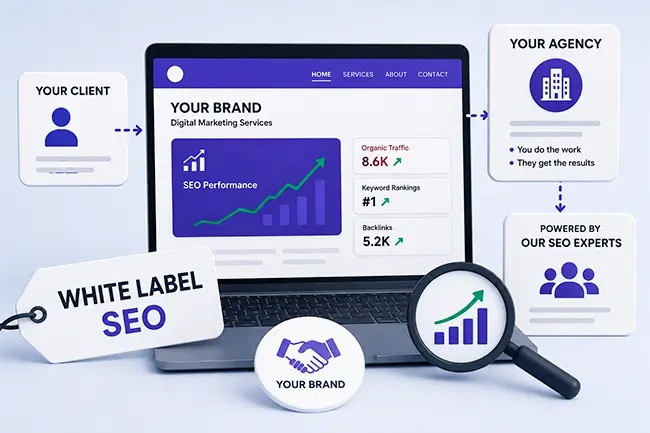

White label SEO is an arrangement where one company performs SEO work, audits, link building, content, technical fixes, reporting, and another company sells and delivers that work to its own clients under its own brand. The end client typically never knows a third party is involved. For a marketing, web design, or PR agency, it’s a way to offer enterprise-scale SEO services to clients without hiring, training, and managing an entire in-house SEO team.
The model exists because SEO is a specialized, ongoing discipline that’s expensive to build internally but relatively straightforward to plug in externally, provided the partnership is set up with the right expectations on both sides.
How white label SEO actually works
The structure is consistent across most white label arrangements, even though the specifics vary by provider:
- The agency (the reseller) sells SEO services to its own client, often bundled with other services like web design or paid media, at a price the agency sets.
- The white label provider does the actual work behind the scenes, audits, keyword research, content, link building, technical implementation, entirely under the agency’s branding.
- Reporting is rebranded. Dashboards, PDF reports, and communications are typically white-labeled with the reselling agency’s logo and colors, not the provider’s.
- The end client deals only with the agency. In most arrangements, the provider has no direct contact with the final client at all; the agency acts as the single point of contact and relationship owner.
The agency keeps the margin between what it charges its client and what it pays the white label provider, while the provider gets steady, recurring work without needing to run its own sales and client-management operation for every account.
White label vs. private label vs. reseller: the terminology, clarified
These terms get used loosely and interchangeably, but there are meaningful distinctions worth knowing:
White label implies the work is fully rebranded and the end client has no visibility into who’s actually doing it. This is the most common arrangement in SEO.
Private label is sometimes used the same way as white label, though it more precisely refers to a product or service built specifically for one reseller’s brand, rather than a shared service simply relabeled for multiple resellers.
Reseller is a broader term that can include arrangements where the end client does know a third party is involved, and simply purchases through the agency as a matter of convenience or bundled pricing, rather than full brand concealment.
In everyday agency conversation, “white label SEO” is used as the umbrella term for all of these, so it’s worth clarifying with any potential partner exactly which model they operate under.
What’s typically included in a white label SEO package
Most providers structure their offerings around the same core service areas:
- Technical SEO audits and fixes: site speed, crawlability, indexation, structured data
- Content creation: blog posts, service pages, and other SEO-driven content
- Link building and outreach: earning backlinks on the client’s behalf
- Local SEO: Google Business Profile management, citation building, review strategy
- Reporting and analytics: branded dashboards, ranking reports, and performance summaries the agency can present as its own
Some providers offer these as standalone modules an agency can mix and match; others bundle everything into fixed-tier retainer packages.
Pricing models you’ll typically encounter
Per-project pricing:
A fixed fee for a defined scope, like a one-time technical audit or a content package, suited to agencies with irregular or one-off SEO needs.
Monthly retainer:
A recurring fee for ongoing work, most common for agencies reselling SEO as a continuous service to their own retainer clients.
Hourly or task-based pricing:
Billing for specific deliverables (a set number of articles, a set number of backlinks), which gives agencies more granular control over margin but requires more active management.
Revenue share:
Less common, but some arrangements split a percentage of what the agency charges its end client rather than charging a flat rate, aligning incentives but requiring a high level of trust between both parties.
How to evaluate a white label SEO partner
Check reporting transparency: You’ll be presenting this work as your own, so ask to see sample reports before committing. If the reporting is unclear or hard to rebrand cleanly, that friction becomes your problem with every single client.
Ask about communication turnaround: Since you’re the buffer between the provider and your client, slow response times on the provider’s end become client-facing delays on yours.
Confirm quality control processes: Ask specifically how content is reviewed, how links are vetted for quality and relevance, and how technical work is tested before being marked complete. A provider that can’t answer this clearly is a quality risk you’ll inherit.
Understand scalability: If you land three new clients in the same month, can the provider absorb that volume without a quality drop? This matters more as your own client base grows.
Look for industry or niche experience where it matters: Legal, medical, and finance clients in particular often need SEO work that accounts for compliance and content accuracy requirements; a generalist provider without that experience can create real risk for those verticals.
The trade-offs worth knowing upfront
White label SEO isn’t a shortcut without any downsides. The agency gives up some direct control over execution quality and timelines, and if something goes wrong (a missed deadline, a low-quality piece of content, a link building mistake that draws a manual penalty) it’s the agency’s name and client relationship on the line, not the provider’s. This is exactly why the evaluation criteria above matter more than price alone when choosing a partner. A cheaper provider that creates rework, client complaints, or reputational risk isn’t actually cheaper once that’s factored in.
For franchise and multi-location businesses evaluating whether to build SEO capability in-house versus working through an agency partner that itself uses white label support, the same trade-off applies at one level removed: the question is always whether the quality and communication controls in place are strong enough to trust the work with your brand.
Who white label SEO makes sense for
- Web design and development agencies that want to offer post-launch SEO without hiring specialists
- PR and content marketing agencies looking to round out their service offering
- Freelancers and small consultancies that want to take on larger SEO retainers than they could deliver solo
- Larger agencies with overflow capacity issues, using white label support during growth periods before hiring in-house
It tends to make less sense for agencies whose core differentiator is deep, hands-on SEO expertise itself, since outsourcing the work undercuts the thing clients are specifically paying for.
FAQs
Is white label SEO the same as SEO reselling?
Broadly yes, in everyday usage, though “reseller” can sometimes describe arrangements where the end client knows a third party is involved, while “white label” specifically implies full brand concealment.
Do end clients ever find out a white label provider is doing the work?
Not typically, and most agreements include confidentiality terms preventing the provider from contacting the end client directly or disclosing the arrangement.
How much does white label SEO typically cost?
Pricing varies widely by provider and service scope, from a few hundred dollars for a single audit to several thousand per month for full-service retainer work across multiple clients.
What's the biggest risk of using a white label SEO provider?
Quality and communication issues that reflect on the reselling agency rather than the provider, since the end client’s relationship is with the agency, not the third party actually doing the work.
Is white label SEO worth it compared to hiring in-house?
It depends on volume and strategic priorities. For agencies without enough consistent SEO demand to justify a full-time hire, white label support is typically more cost-effective; agencies where SEO is a core differentiator often benefit more from building in-house expertise over time.