
A citation, in SEO terms, is any online mention of your business’s name, address, and phone number, commonly shortened to NAP, whether or not that mention includes a link back to your website. Think Google Business Profile, Yelp, Bing Places, industry directories, and local chamber-of-commerce listings. Citations are one of the core building blocks of local SEO, and local SEO citation building is foundational work that’s easy to overlook, because messy citations quietly undermine local rankings more often than most business owners realize.
If you’ve mostly thought about SEO in terms of backlinks and content, citations can feel like a strange, less glamorous cousin. They are. But for any business that depends on local, “near me,” or map-pack visibility, they matter more than a single blog post’s worth of content ever will.
What counts as a citation, exactly
A citation requires three core pieces of information, consistently presented:
- Name: your business’s exact legal or trading name
- Address: physical location, formatted the same way every time
- Phone number: ideally a local number, not a call-tracking number that changes across listings
Citations fall into two broad categories:
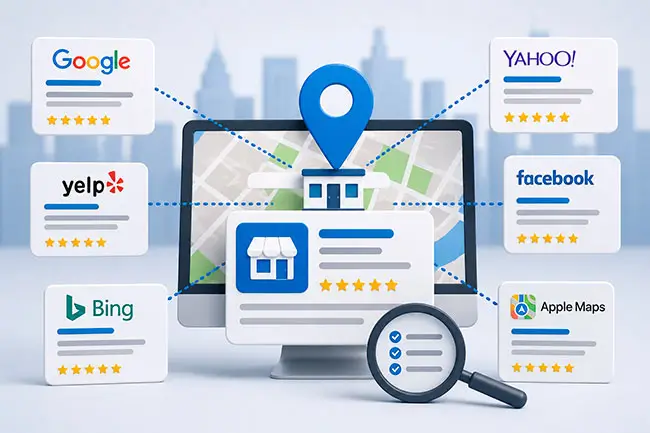
Structured citations live on dedicated business directory and data-aggregator platforms, where your NAP sits in defined fields, name field, address field, phone field, rather than embedded in free-flowing text. Google Business Profile, Yelp, Bing Places, Apple Maps, Facebook Business, and industry-specific directories are all structured citations.
Unstructured citations appear in regular content, a local news article that mentions your business name and neighborhood, a blog post that references your address in passing, a press release. These carry weight too, but they’re harder to build deliberately and easier to lose track of.
Why citations matter for SEO
Google has been fairly direct about what drives local search rankings: proximity, relevance, and prominence. Citations feed directly into that third factor, prominence, by acting as corroborating evidence that a business is real, established, and consistently represented across the web.
The mechanism is trust, not links. Unlike a backlink, most citations don’t pass traditional link equity, plenty of directory listings are nofollow or don’t link at all. What they do instead is give Google (and other engines, and increasingly AI-driven answer tools) independent confirmation of who you are and where you’re located. The more consistent, numerous, and reputable those confirmations are, the more confidently Google can surface your business for local queries and populate the local map pack.
Inconsistent citations do the opposite. If your business is listed as “NEXOPTIMIZE Ltd” on one platform, “Nex Optimize” on another, and shows a phone number that hasn’t been updated in three office moves, Google has to work harder to confirm it’s the same business, and it may simply trust the listing less.
Common citation sources worth prioritizing
Not every directory is worth the same effort. In practice, citation building tends to fall into a rough priority order:
- Google Business Profile: the single most important listing for local visibility, directly feeding the map pack and local knowledge panel.
- Major data aggregators: platforms like Data Axle, Foursquare, and Neustar Localeze feed NAP data downstream to dozens of smaller directories and apps, so fixing information here has a multiplying effect.
- General directories: Yelp, Bing Places, Apple Maps, Facebook Business.
- Industry-specific directories: relevant to your sector (legal directories for law firms, home-service directories for contractors, and so on).
- Local and niche directories: chamber of commerce listings, local business associations, regional directories.
Chasing volume across dozens of low-quality directories with little traffic or authority isn’t where the value is. A smaller number of accurate, high-authority citations consistently outperforms a large number of scattered, inconsistent ones.
How to build and clean up citations
Audit first
Before adding new citations, find out what already exists. Search your business name, phone number, and old addresses (if you’ve moved) to surface listings you may not have created yourself, data aggregators and directories often auto-generate listings from public records.
Fix inconsistencies before adding new listings
Standardize your NAP format exactly as you want it to appear everywhere: same abbreviation style (St. vs Street), same phone number, same business name. Update every existing listing to match before building new ones.
Claim and verify the major platforms
Google Business Profile and Bing Places both require verification, usually by postcard, phone, or email, so factor in lead time.
Work through data aggregators
Correcting information at the aggregator level fixes it downstream across many smaller sites automatically, which is far more efficient than manually updating dozens of individual directories one at a time.
Monitor, don’t set and forget
Citations drift: directories get scraped and re-published with outdated information, old listings resurface after a business move, and duplicate listings appear when a location is claimed more than once. Periodic audits catch this before it erodes local rankings.
Common citation mistakes
- Duplicate listings. Multiple Google Business Profile listings for the same location confuse both users and Google’s systems, and can actively suppress local rankings.
- Inconsistent formatting. “123 Main St” versus “123 Main Street” seems trivial but adds up across dozens of listings.
- Outdated information after a move or rebrand. Old addresses and phone numbers linger far longer than most businesses expect.
- Using call-tracking numbers as the primary listed number. This breaks NAP consistency and can confuse aggregators.
- Chasing citation quantity over quality. Ten accurate, relevant citations beat a hundred inconsistent ones.
FAQs
What are citations in SEO used for?
They confirm a business’s existence, name, address, and phone number consistently across the web, which feeds into Google’s local ranking systems, particularly the “prominence” factor behind map pack and local search visibility.
Do citations need a backlink to count?
No. Most citations don’t include a link at all, and their value comes from consistent NAP data, not link equity.
How many citations does a business actually need?
There’s no fixed number. A smaller set of accurate, high-authority citations, especially on Google Business Profile and major data aggregators, outperforms a large number of low-quality, inconsistent ones.
Do citations matter if my business isn't local?
Less so. Citations are primarily a local SEO signal. Businesses without a physical location or local service area, purely online or national e-commerce brands, will see far more value from backlinks and content than from citation building.
How long does it take for new citations to affect rankings?
Data aggregators can take several weeks to propagate updates downstream, and Google’s own systems may take a similar amount of time to reflect changes in local rankings. Citation work is a foundation-building exercise, not a quick fix.
Can bad citations hurt my SEO?
Yes. Inconsistent or duplicate listings can actively undermine local rankings by making it harder for Google to confirm your business’s identity and location with confidence.