
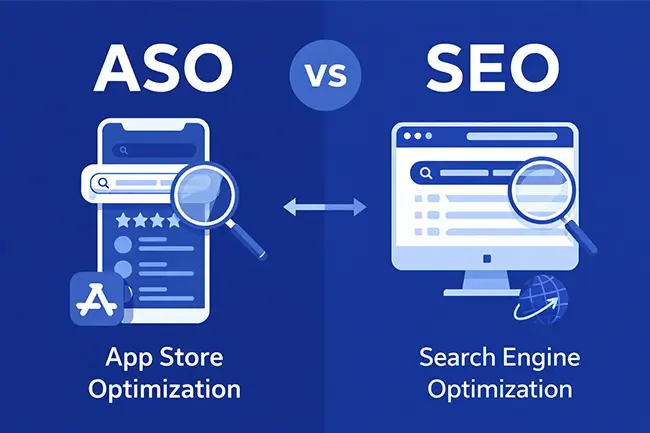

ASO and SEO solve different growth problems, and choosing the wrong one can cost businesses time, budget, and momentum. SEO focuses on driving organic traffic to websites through search engines, while ASO is designed to increase app visibility, installs, and conversion rates inside app stores like Google Play and the Apple App Store.
For businesses with mobile apps, this distinction matters more than ever. App store users behave differently than search engine users. They search with higher intent, shorter decision windows, and far less tolerance for unclear value. That means strategies that work in SEO often fail when applied to app discovery.
The mistake most businesses make is treating ASO and SEO as interchangeable channels. They are not. Understanding where your audience discovers you and where conversion actually happens is the difference between compounding growth and wasted investment.
What is App Store Optimization (ASO)?
App Store Optimization is the process of improving an app’s visibility, conversion rate, and retention signals within app stores like the Apple App Store and Google Play.
ASO focuses on how users discover apps and what convinces them to install.
Core ASO elements include:
- App title and subtitle optimization
- Keyword field and description relevance
- Icons, screenshots, and preview videos
- Ratings, reviews, and user sentiment
- Conversion rate from impression to install
Unlike SEO, ASO is not about traffic volume. It is about install intent.
Businesses that depend on mobile acquisition often rely on professional App Store Optimization services to align discovery with conversion and long-term app growth.
What is Search Engine Optimization (SEO)?
SEO is the practice of improving a website’s visibility in search engines such as Google and Bing to drive organic traffic.
SEO targets users who are researching, comparing, or learning before taking action.
Key SEO components include:
- Keyword research and intent mapping
- Content optimization and internal linking
- Technical performance and page experience
- Authority signals such as backlinks and brand trust
SEO supports long-term discoverability across multiple pages, topics, and stages of the buyer journey.
For a foundational overview of how Google evaluates websites, Google’s own documentation on search systems provides helpful context for ranking signals and quality guidelines.
ASO vs SEO: The differences that actually matter
Platform and user mindset
SEO targets users browsing the open web.
ASO targets users already inside app stores with higher install intent.
Ranking signals
SEO relies heavily on backlinks, content depth, and technical health.
ASO relies on metadata relevance, conversion rates, retention, and reviews.
Conversion behavior
SEO conversions happen off-platform through forms, carts, or demos.
ASO conversions happen instantly through installs.
Speed of impact
SEO compounds slowly and rewards consistency.
ASO changes can show measurable results within weeks when executed correctly.
Conversion metrics: Installs vs actions
In ASO, success is measured by:
- App store impressions
- Install rate
- Retention and engagement
- Uninstall behavior
In SEO, success is measured by:
- Click-through rate
- On-site engagement
- Leads, sales, or sign-ups
Both channels optimize for user action, but the action itself is fundamentally different.
Data availability: What you can and cannot measure
SEO provides granular data. You can see impressions, clicks, keyword volume, device segmentation, and user paths.
ASO data is more limited. While you can track downloads, conversion rates, and retention, keyword-level attribution is less transparent.
This is why ASO relies more heavily on testing, iteration, and pattern recognition rather than raw keyword metrics alone.
When SEO is the better investment
SEO should be prioritized when:
- Your website is a primary revenue or lead source
- You rely on education, content, or long-tail discovery
- Users research heavily before converting
- You need visibility beyond mobile ecosystems
SEO builds authority across time and multiple entry points.
When ASO is the smarter choice
ASO should be prioritized when:
- Your product is primarily a mobile app
- Paid acquisition costs are rising
- Your app has visibility but poor install rates
- You operate in competitive app categories
For mobile-first businesses, ASO is often the most cost-efficient growth channel available.
How ASO and SEO work best together
ASO and SEO are not competitors. They solve different stages of the same problem.
SEO builds awareness, trust, and demand.
ASO captures intent at the moment of decision.
Businesses with both a website and an app perform best when keyword insights, messaging, and conversion data flow between both channels.
Common mistakes businesses make
- Treating ASO as a one-time setup
- Expecting SEO-style timelines from app store optimization
- Ignoring creative assets in ASO
- Separating SEO and ASO data instead of aligning it
Avoiding these mistakes is often the difference between compounding growth and stagnation.
Final verdict: ASO or SEO?
The right investment depends on how users discover you and where conversion happens.
If installs drive revenue, ASO is foundational.
If education and discovery drive demand, SEO is essential.
If you operate across both, alignment wins.
FAQs
What is the main difference between ASO and SEO?
SEO optimizes websites for search engines, while ASO optimizes app listings for visibility and installs in app stores.
Can ASO and SEO be used together?
Yes. SEO builds awareness and intent, while ASO converts high-intent users into app installs.
How long does ASO take to show results?
Most apps see measurable improvements within 2 to 6 weeks after optimization.
Is App Store Optimization cheaper than paid app ads?
In most cases, yes. ASO delivers compounding organic installs without ongoing ad spend.
Do all apps need App Store Optimization?
Any app competing in public app stores benefits from ongoing ASO.
What is the difference between SEO and ASO?
SEO improves a website’s visibility on search engines. ASO improves an app’s visibility in app stores. SEO brings site traffic; ASO drives app downloads.
What businesses need SEO most?
Local businesses, e-commerce stores, service providers, healthcare practices, and B2B companies that rely on online leads benefit most from SEO.