
Can you believe how much has changed in just a few years? Back in 2022, “search” was a pretty simple concept. You’d type a keyword into a bar, hit enter, and scroll through a list of blue links. If your business was on the first page, you were essentially printing money. But as we navigate early 2026, that linear path has become a web of AI conversations and instant answers.
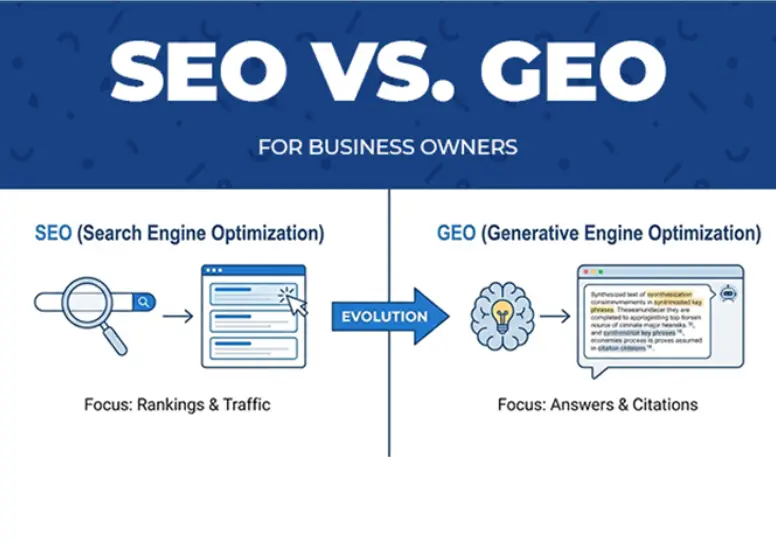
This shift has given birth to a new discipline: Generative Engine Optimization, or GEO. While SEO was always about helping a search engine rank your specific page, GEO is about helping an AI model choose your brand as its primary source of truth. Imagine SEO is like the library filing system that helps people find your book. GEO is more like the librarian who has actually read your book and recommends your specific advice to everyone who asks a question. If you aren’t on the librarian’s radar, your book stays on the shelf, unread and forgotten.
SEO: The reliable old guard (Still vital, Still kicking)
Before you go throwing your old SEO strategy out the window, let’s be clear: SEO is not dead. It has just found a new role in the family. Traditional search engines like Google still drive massive amounts of direct traffic to websites. If you are a plumber in Bristol or a lawyer in New York, you still need people to click through to your site to book your services. SEO remains the undisputed king of direct intent and high-level conversion.
In 2026, traditional SEO focuses heavily on the technical health of your site. Are your pages loading in the blink of an eye? Is the mobile experience better than the desktop version? Google still rewards sites that show legitimate “Expertise, Authoritativeness, and Trustworthiness.” You can read more about how Google’s core updates have shifted toward user intent on Search Engine Land. Keywords are less about exact matches today and more about the “why” behind the search. Google’s integrated AI understands what your customers want even when they don’t use the perfect terminology.
Meet GEO: The new kid on the digital block
So, what is this GEO everyone is talking about? Generative Engine Optimization is the practice of tailoring your digital presence so that AI search engines like Perplexity, SearchGPT, and Gemini can easily find, digest, and cite your brand. In the GEO world, a “click” is secondary. The real prize is a “mention” or a “citation.”
When a user asks an AI, “What is the best way to scale a SaaS business in 2026?” the AI won’t give them a list of websites. It will write a two-paragraph response synthesizing the best advice it can find. If the AI says, “According to [Your Brand Name], the focus should be on product-led growth,” you have just earned the ultimate digital endorsement. GEO is about making sure you are the source that the AI trusts enough to quote.
SearchGPT and Perplexity: How they differ from the Google you know
Platforms like Perplexity AI and SearchGPT operate on a different logic than the classic Google search. Google is an aggregator that collects and presents links. SearchGPT and Perplexity are “answer engines.” They don’t just find information; they process it for the user.
Perplexity focuses on real-time data and extreme transparency. It provides a textual summary followed by a list of footnotes or citations. SearchGPT is more conversational, remembering your previous questions and refining the answer as you go. For a business owner, this means your brand footprint needs to be consistent across the whole internet. These AI models aren’t just looking at your website. They are scanning your LinkedIn, your YouTube transcripts, and what people are saying about you on niche forums.
Citations vs. Rankings: The new metric of success
In the past, we were obsessed with “Position 1.” In 2026, we are obsessed with “Citation Frequency.” Being cited by an AI engine is the new gold standard. Why? Because AI-generated answers often take up the most valuable space on a phone or laptop screen. If an AI gives a comprehensive answer and cites your blog as the source, the user instantly sees you as the authority.
This fundamentally changes how we measure success. You might see a dip in “total sessions” in your analytics, but the quality of the traffic you do receive is likely much higher. When a user clicks a citation link in Perplexity, they aren’t just window shopping. They are doing a deep dive into a source that an intelligent system just told them was the best. It is a shift from chasing quantity to securing high-value authority.
Why business owners can’t ignore GEO today
You might be tempted to think that if traffic is going down, search isn’t worth it. That would be a massive mistake. If you ignore GEO, your brand becomes a ghost in the conversations where decisions are made. Imagine a customer asking their AI assistant to “find me a local bakery that offers gluten-free sourdough and delivers within three miles.” If your bakery isn’t in the AI’s “knowledge graph,” you aren’t even in the running for that sale.
AI search is rapidly becoming the default for younger generations. Gen Z and Gen Alpha don’t “Google” things; they ask their AI for a summary. To stay relevant for the next decade, you have to play by these new rules. This isn’t a passing trend. It is a fundamental evolution in how humans interact with information.
The Zero-click dilemma: Visibility without the visit
One of the most challenging parts of 2026 for any business owner is the “zero-click” reality. This is when a user gets all the answers they need directly from the AI and never bothers to click a link. While this sounds like a disaster for your traffic numbers, it is a massive opportunity for brand building.
Think of it as “ambient awareness.” If your brand name is constantly appearing in AI responses as the go-to expert, you are building an incredible amount of trust. When that customer is finally ready to make a purchase, they won’t even need to search. They will come directly to your site or app because the AI has been recommending you as the expert for weeks.
GEO optimization strategies: How to get your brand cited by AI
How do you actually “do” GEO? It is no longer about stuffing keywords into a page. It is about something called “Information Gain.” AI engines love content that adds something new or unique to the conversation. If you are just repeating what everyone else has said, the AI will ignore you.
To win at GEO, you need to provide original data, unique case studies, or deeply expert opinions. Use clear and authoritative language. Instead of saying, “We offer great marketing services,” try saying, “Our marketing framework for 2026 helped three retail brands increase their retention by 40 percent using AI-driven personalization.” The second sentence is packed with facts and specific value that AI models love to cite.
Focusing on Entity Authority and Semantic depth
Modern search engines think in “entities,” not just keywords. An entity can be a person, a place, or a business. Your goal is to make your business a “strong entity.” You do this through consistency. Your name, location, and services should be identical across your website, social profiles, and industry directories.
Semantic depth is about how thoroughly you cover a topic. Don’t just write a short blog post. Create a “topic cluster” that answers every possible question a user might have. If you sell coffee, don’t just talk about the beans. Write about the roasting temperatures, the ethics of the supply chain, and the best brewing methods for different altitudes. This proves to the AI that you are a true authority, making you a prime candidate for a citation.
Structured data: Speaking the AI’s language
If your content is the story, structured data (Schema markup) is the translation that helps the AI read it. In 2026, Schema is no longer an “extra” feature. It is a requirement. By using code tags, you tell the AI exactly what your content represents.
Are you a “LocalBusiness”? Use the schema. Is this an “Article”? Use the schema. By making your data “machine-readable,” you make it much easier for SearchGPT or Perplexity to pull your specific details into their answers. It is like giving the AI a map that points directly to the most important parts of your business.
Building a unified growth engine for the future
The winners in 2026 don’t choose between SEO and GEO. They build a strategy that uses both. You use traditional SEO to capture the “buyers” who are searching for specific products on Google. You use GEO to capture the “researchers” who are asking broad questions to their AI assistants.
This hybrid approach ensures you are visible at every single stage of the customer journey. Whether someone is looking for a quick link or a deep conversational answer, your brand is there. It is a double-layered strategy that protects your business from being pushed out by more agile competitors who only focus on one platform. Master both, and you will own the search landscape.
Conclusion: The future of finding and being found
We are witnessing the biggest transformation in search since the internet began. The competition between GEO and SEO is not a battle to the death. It is a partnership. As a business owner, your goal is to make sure your brand is visible to both humans and the AI models they rely on. Focus on being factual, being helpful, and being consistent. If you can strike the right balance between traditional ranking and AI citations, you won’t just survive the 2026 shift. You will lead the way.
FAQ: Your questions answered
Is traditional SEO completely dead in 2026?
How do I know if I’m being cited by SearchGPT or Perplexity?
Does GEO require more technical skill than SEO?
It requires a different mix. While technical site health is still important, GEO relies more on “semantic clarity” and “entity building,” which is about how clearly you present facts and authority.
Will AI answers steal all my website traffic?
For simple, informational queries, yes, traffic might drop. But for complex or high-intent searches, AI usually drives “higher-quality” traffic because the user has already been “pre-sold” by the AI’s recommendation.
What is the most important factor for GEO success?
Information gain. Providing unique, verifiable, and expert-level information that the AI can’t find anywhere else is the best way to get cited.
Do backlinks still matter for AI search engines?
Yes, but they are viewed as “trust signals.” An AI engine is more likely to trust your content if it sees that other authoritative entities are talking about you.
Should I stop focusing on keywords?
Don’t stop entirely, but stop obsessing over exact matches. Focus on “topics” and “entities.” Write for the human intent behind the query, and the AI will handle the rest.